2014 has been hectic for me as I moved and look for a job. But I never set Seven Noble Knights entirely aside and will have great blogs again in February.
Today I have a post up at Unusual Historicals that retraces the possible geography of a special day in the life of Alfonso X, el Sabio, in Sevilla. Alfonso X gave the mandate to write the history from which I take the story of the Seven Noble Knights (among many other accomplishments). Sevilla was Alfonso's favorite city after its reconquest, and is mine now, in spite of loyalties spread all over the Iberian Peninsula. I've included lots of pictures and I hope it's a fun and informative experience. Check it out if you like Spain and/or the Middle Ages!

Wednesday, January 29, 2014

Tuesday, December 17, 2013
A Medieval Coin
A little coin appears in Seven Noble Knights, once Mudarra has been in Castile for a while. He wants to give money where it wouldn't be seemly, so he mitigates his crime by casting a few obolos into the street. Described as parchment-thin and barely worth enough to buy a loaf of bread, Mudarra's coins are based on something I have in my possession.
I got this little coin on Ebay (what can't you get there?) for little money ten years ago. The vendor told me it was from the reign of Alfonso X el Sabio, pretty much my only reason for being alive at the time, so I couldn't resist. I was later able to verify in a museum in Burgos that this is just like other obolos out there, so I feel pretty confident that it's the real deal.
 The front shows a castle, the emblem of Castile, and the Latin letters CASTELLE.
 The back shows the lion of León and bears the inscription LEGIONIS.
Of course, Mudarra couldn't have thrown a coin that bore the emblems of both kingdoms because he lived during a time when Castile was an independent county officially still part of León. It's still likely obolos were struck at the time because of the eternal need for very small values of coins. Aside from the thinness and small circumference, one mark of a coin of small worth is that it hasn't been cut to make even smaller values. Most important to me as the author, this coin was minted during the reign of my favorite king in the history of the world and the same king whose team compiled the books where we find the first traces of Mudarra's story.
This coin weighs almost nothing, but I can feel the seven hundred years in the patina. It brings me that much closer to the realities of the lives of my characters.
Happy holidays! See you again from my new home in the new year.
I got this little coin on Ebay (what can't you get there?) for little money ten years ago. The vendor told me it was from the reign of Alfonso X el Sabio, pretty much my only reason for being alive at the time, so I couldn't resist. I was later able to verify in a museum in Burgos that this is just like other obolos out there, so I feel pretty confident that it's the real deal.


Of course, Mudarra couldn't have thrown a coin that bore the emblems of both kingdoms because he lived during a time when Castile was an independent county officially still part of León. It's still likely obolos were struck at the time because of the eternal need for very small values of coins. Aside from the thinness and small circumference, one mark of a coin of small worth is that it hasn't been cut to make even smaller values. Most important to me as the author, this coin was minted during the reign of my favorite king in the history of the world and the same king whose team compiled the books where we find the first traces of Mudarra's story.
This coin weighs almost nothing, but I can feel the seven hundred years in the patina. It brings me that much closer to the realities of the lives of my characters.
Happy holidays! See you again from my new home in the new year.
Wednesday, November 27, 2013
The Cutting Room Floor
 |
| Doña Lambra wonders why I cut her intro chapter. |
I always called it Chapter II because I knew the first chapter had to be much more exciting. Because it's the first piece of historical fiction I ever wrote, it has a hesitancy about it. You can almost feel me reaching out my senses and trying to describe what I thought it was like to live in Northern Spain in the year 974. It contains a lot of context and sympathizes deeply with Doña Lambra, which caused problems in my critique group later when her true nature was revealed. When I finished the first draft of the novel, I excised the first half, with the silk vendor, and eventually the second half became attached to the latest version of Chapter I. Now, the battle in the first chapter cuts directly to the wedding preparations in the former Chapter III.
Anyway, I've done my duty and killed my darling and now I lay its body out for you to view. RIP, Chapter II. (To cheer yourself up, you can watch the trailer!)
Chapter II
…una duenna de muy grand guisa, et era natural de
Burueva, et prima cormana del conde Garçi Fernández, et dizienle donna Llambla. (I put an excerpt from the Estoria de Espanna, thirteenth-century text at the head of each chapter in the first draft. This introduces Lambra, just like the chapter does in more detail.)
The sun began to relent from
its long day’s punishment of the estate of Busto de Bureba. The fish in the
river sought out the barely forming shadows cast by stones and branches. Inside
a stone house, under a thatched roof, twenty maidservants and their lady
cleaned up the dinner table, planned a cool evening meal, brought in the
washing, and put away the day’s sewing without bumping into each other.
Doña Lambra looked out the open door
when she heard a tinkling of bells on the road.
“Good evening, my lady!” cried the
peddler, halting his donkey in the middle of the road directly in front of her
house.
“What are you selling there?” Doña
Lambra wiped her brow, lifted her apron, and headed toward the packs on the
donkey’s back.
“I’m not really selling anything yet.
I’m on my way to France, where I can get the best price for these Moorish silks
and finery. But I might bring myself to part with something for the sake of one
so obviously noble.”
Lambra stood a little straighter and
felt the heavy wool dress scratch her shoulders through the wicked moisture.
She tossed her head and her flaxen braids leapt up before they reached her
waist again. “Well, I won’t buy anything before I see it.”
“Of course not, lady.”
He reached high and opened the nearest
bag’s latch. The lid popped open with the force of the tightly packed fabrics
inside. “This one on top is probably the best I have.” He pulled on a corner of
the silk and Lambra quickly appraised its luster and smoothness.
“Green?” she said.
“Don’t turn up your nose at it, my
lady. It’s the most popular color in the very caliph’s harem in Córdoba. It’s
sure to become the highest fashion, especially if other ladies see you wearing
it.”
“Sell it to the French ladies. I’ll
have no pagan colors.”
The peddler tugged at a corner of the
bolt underneath the green and a mass of azure slid into view with a swooshing
sound. He came rather closer than Lambra would have liked and held it under her
chin. “Just as I thought! A perfect match for your eyes! Or even the
Mediterranean Sea.”
“My eyes aren’t blue,” she said,
backing away.
“They certainly are! I must have a
looking glass in here somewhere.” He rummaged through three different packs.
The donkey flicked his tail and made the bells jingle. Doña Lambra tried to
imagine the peddler all alone leading his donkey, loaded high with goods, through
the rocky terrain toward France.
“Are you going through the Roncesvalles
Pass unaccompanied and with bells?”
“Just my donkey and me,” he replied.
“And the bells.”
“You should really pack the bells away
before you get into the Basque country. You have no reason to announce your
presence among those savages.”
He held a piece of polished metal
between his thumb and forefinger up to Lambra’s eyes for her to see. “I’ve
traveled through the Pyrenees many times. Don’t you think that blue silk favors
you?”
“Now, how could I possibly tell whether
the fabric favors me in such a tiny glass?” she said, taking the glass from
him. “I can’t see myself and the silk at the same time!”
He considered the fabric, eyed the pack
it had come from, and in a great sweeping motion, pulled his dinner knife from
his belt and slashed off a square of the silk. He handed it to Lambra and
folded the rest of the bolt away, saying, “You see? A perfect match. You could
embroider that swatch with your golden hairs and no one would know it wasn’t
straight from a treasure chest.”
She held the fabric under her eye and
glimpsed two blue shapes in the glass. Maybe it was just the sky. She looked
up, and the peddler had already fastened all the packs. “A gift from one so
humble to one so haughty,” he said.
“Thank you,” she mumbled, handing back
the looking glass.
He stuffed it into a pocket and tugged
at the donkey’s bridle.
Doña Lambra turned back toward the
door, where she noticed five faces of her maids disperse like a puff of smoke.
She sat on the stone bench under the eaves of her house and watched the peddler
jingle his slow way toward the mountains. She was glad he hadn’t pressured her
to buy, because she had nothing to give in trade for silks. She had
administered all her own land since her father had passed away five years
earlier, so she knew that maintaining so much land and so many people often
meant sacrifice and frugality before fashion. She picked up the end of her
braid and set it against the fabric. Yes, her hair almost could pass for gold
thread. Maybe she could have one of the girls embroider stars and moons on the
fabric and set it into a bodice. Everyone at mass would think she was wearing
the latest plunder from Andalusia, perhaps a gift from another admiring knight.
Her maids’ voices floated out the
doorway on some farmer’s melody. Always gossiping, joking, and laughing when
they thought she couldn’t hear. Well, she’d make them work hard enough
tomorrow.
An eagle shrieked across the sky in
search of prey. Lambra looked down the road to the west. What could that be?
This road was becoming a regular thoroughfare. Two knights in chainmail headed
up a twenty-man retinue, all on horseback. As they neared the house, one of the
two front men lifted up the standard, a castle on a white field.
Doña Lambra tucked the blue square into
her neckline, gathered up her skirts, and ran through her front door shouting.
“My cousin’s here! He’s got twenty knights with him! What were we having for
supper? How much wine is there?”
All the ladies dropped what they were
doing and scurried to their preassigned tasks for just such an occasion:
cutting more old bread for plates, clearing out the sides of the hall for
sleeping space. Only Justa, who had been born into the household at nearly the
same time as doña Lambra, followed alongside her lady as she charged through
the great room to the kitchen at the far end.
“You told us to just make a salad:
cucumbers, radishes, garlic, some nuts, maybe some quince jelly.”
“No garlic!” Lambra didn’t acknowledge
Justa, whose words were merely an embodiment of her own thoughts. “No garlic!”
She seized the cloves from the table where the cook was about to chop them and
threw them on the floor, where a couple of puppies began to roll them around
the packed earth and straw. “No garlic for the Count of Castile! Isn’t there
any pepper left at all? Why didn’t he send ahead so we could get some quail or
slaughter some hens? Justa! Send the boys for rabbits!” Justa ducked out the
side door. “What about the pepper?”
The cook replied, “There’s about a
spoonful left, my lady.”
“Stew the rabbits in the vinegar and
put the pepper on at the last minute so it’s still fresh and pungent at the
table. I’ll trust you to find some cheese to go with the quince, and for the
love of God, make more salad!”
The cook tried not to sweat into the
stew pot where she set some water to boil and chopped cucumbers as fast as she
could. Lambra strode back across the house and paused just inside the front
door to inhale and exhale deeply. She smoothed the hair at her temples and
stepped outside.
The retinue was already arriving at the
house. Lambra saw the Count of Castile in the center, also dressed in mail. His
undoubtedly hot and blinding helmet was secured to the back of his horse’s
saddle. Resting his hand gently on it, he dismounted in one easy motion. Lambra
started toward him, exclaiming, “Cousin García! What fortunate wind brings you
here?”
“Now, now, cousin,” he replied, taking
her into an embrace, “you know better than to address me like that. It’s been
four years now.”
“I’m sorry, your grace, most high and
noble Count, leader of all Castile!” She comically bowed from the waist to
restore some fragment of their playful childhood.
“You’re forgiven, my shrewd cousin!” He
chuckled and laid his hand on the top of her head as if in blessing.
She stood and looped her arm through
his to seal the intimacy. The other knights had dismounted, so she said, “Let
us lead your noble retinue to the stables to care for their fine steeds.” She
deliberately bypassed the door and in hopes that the extra time would allow her
maidens to make the hall look as if it were always sparkling clean and ready
for important visitors. Maybe by the time they went inside, the boys would have
brought and cleaned the rabbits and the male laborers would have arrived to
welcome the masculine retinue more appropriately than her maids could.
The Count unsaddled, brushed, and fed
his own horse. Lambra couldn’t help but wait for him outside by the river in
the cooling breezes. She let the reeds brush against her hands while she
inhaled the wet river fragrance mixed with summer blossoms. The eagle cruised
across the darkening sky toward its nest.
Her cousin came out to meet her by
himself. “I’ve sent the men inside. I have to tell you why I’m here, Lambra,
and this might be the best place for it.”
She took his outstretched hand and
noticed the way he avoided her gaze. “What can it be?”
“Lambra, you’re such a beautiful woman,
and so rich in lands, I can’t think of any man who truly deserves you!”
She squeezed his slippery hand.
“Cousin, has something happened to your wife?” Did he want to marry doña
Lambra?
He smiled and looked at her. “She’s
very well. She’s in Burgos, expecting our second child.”
“That’s wonderful. Praise be to God!”
García looked away again and stared
into the sun as it eased below the mountains. “You may have heard about the
happy conclusion of the siege of Zamora.”
“Oh, yes! We were all so glad to hear
that that beautiful city remains within Castile.”
“Well, Zamora is more of a border
outpost than Burgos, or even Bustos de Bureba, but I suppose it has its charms.
A good river, and it’s strategic for keeping the Kingdom of León in check… But
did the news come with the reason for the end of that interminable siege?”
“There was a name, someone I’d never
heard of, from far away.”
“Ruy Blásquez. Ruy Blásquez saved the
city of Zamora. I would still be there today if he hadn’t come to my rescue.”
Doña Lambra thought the Earth shifted
beneath her as she realized what was really happening. She was being given
away. Married off, passed from hand to hand as if she had nothing better to do,
as if Bureba could get by without her.
Doña Lambra had not expected to be
given in marriage. With both of her parents already passed into the next world,
she had been raised principally by dueñas and other servants who could
wield no real authority over her. Now well into puberty, she had been taking
inventory of all the surrounding noblemen, deciding which lands she might like
to administer, so as to arrange her own nuptials. It even occurred to her that
she needn't marry at all, but simply govern her own holdings until such time as
her Father in Heaven saw fit to pass them on to his Holy Church.
But she was nothing if not shrewd, and
if she had considered it, she would have realized that as the cousin of García
Fernández, the Count of Castile, she would likely end up as a reward to one of
his loyal warriors.
“Some vassal rescued you? I should
think he was merely doing his duty.”
“Oh, Lambra, you can have no idea how
far above the call of duty he went. He brought one thousand knights and united
them all under Castile’s standard. And now we can fly that flag over Zamora! I
know you don’t know any other way for things to be, but it was only my father
Fernán González – less than a generation ago! – who declared Castilian
independence from León and it’s far from a consolidated reality. By bringing so
many to rally for our country, Ruy Blásquez has made himself my most valuable
vassal. And so, when he asked me to find him a wife, naturally I thought of
you, the richest and most noble of all my relatives.”
Doña Lambra let the orange and gold
rays spewing from behind the mountain burn her eyes. “But who is this Ruy
Blásquez? How old is he?”
“He’s well established.” The Count
walked around and tried to face his cousin, but she turned away from him every
time. “He’s completed his thirty-fifth year.”
She couldn’t help but wring her hands
at the thought of a grey beard and rotting teeth. Well, but maybe he wouldn’t
live that long, then she would administer all the territory they had between
them.
“Is he landed?”
“He has a few parcels in the region of Lara, called
Vilviestre.”
“A few parcels? I am the lady,
practically the countess, of all of Bureba! Thousands of landholders owe their
fealty to me and no one else!”
“Thousands? Hundreds, perhaps.”
“Thousands!”
“Lady, you forget yourself. We may be
cousins, but I am the Count here. All of ‘your’ vassals ultimately work for
me.”
Her eyes found his, but he had to look
away. She bowed her head and whispered, “Lara’s so far. I never imagined going
so far.”
He caught her as she collapsed,
sobbing.
García entered the house first. As
Lambra’s eyes adjusted to the firelight, she saw all of her people seated on one
side of the great table, knives out, bread trenchers in front of them, with the
Count’s men seated on the other side. They had wisely left the head of the
table unoccupied for the Count and the lady of the house. She wiped her eyes
one last time. “Pour the wine!” she said a little too loudly. “We have much to
celebrate! I’m to be wed this year!”
Thursday, November 7, 2013
Entertaining, Fast and Fun Trailer Debut
I've been working on this for about six months now. It's more of a pitch than a trailer, simply because the book isn't published yet. I hope it's entertaining and makes you interested in the story. Please let me know!
I couldn't have accomplished this by myself.
The talented graphic novelist or "story artist" Ayal Pinkus did the drawing and painting that makes this trailer so special. I can never thank him enough for lending his talent to bringing the Seven Noble Knights to life. It's incredible to see the characters and events that have so far only been words on pages or screens this much closer to flesh and blood. Our collaboration was amazingly fruitful.
The professional voiceover was done by James Scott.
The background music was chosen after much agonizing. It's "Non me mordas, ya habibi" (Don't Bite Me, oh Lover), a jarcha from medieval Andalusia. The text is written in a proto-Spanish that has a strong relationship to what the characters in Seven Noble Knights would have been speaking, and when he goes to Córdoba, Don Gonzalo hears a similar jarcha. This version is performed by the Eduardo Paniagua Ensemble Música Antigua and is available on the album El crisol del tiempo.
Thanks so much for watching. If you feel inclined to do me a favor, watch it many more times — as many as you can — and share it with any of your friends interested in historical fiction. Thank you!
I couldn't have accomplished this by myself.
The talented graphic novelist or "story artist" Ayal Pinkus did the drawing and painting that makes this trailer so special. I can never thank him enough for lending his talent to bringing the Seven Noble Knights to life. It's incredible to see the characters and events that have so far only been words on pages or screens this much closer to flesh and blood. Our collaboration was amazingly fruitful.
The professional voiceover was done by James Scott.
The background music was chosen after much agonizing. It's "Non me mordas, ya habibi" (Don't Bite Me, oh Lover), a jarcha from medieval Andalusia. The text is written in a proto-Spanish that has a strong relationship to what the characters in Seven Noble Knights would have been speaking, and when he goes to Córdoba, Don Gonzalo hears a similar jarcha. This version is performed by the Eduardo Paniagua Ensemble Música Antigua and is available on the album El crisol del tiempo.
Thanks so much for watching. If you feel inclined to do me a favor, watch it many more times — as many as you can — and share it with any of your friends interested in historical fiction. Thank you!
Wednesday, October 23, 2013
Touching the Past
I was going through some photos I took when I was in Burgos in October 2005 and was thrilled to find this gem:
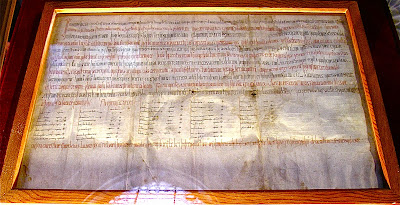
It's a document granting Covarrubias to a noble monastery. It's signed by Count García Fernández, supreme leader of Castile and a character in SNKL. His wife Ava also signs. She isn't a character in SNKL, but a strong possibility for a sequel. The document dates from 972, ever so close to the year SNKL opens.
This wonderful piece of faded, wrinkled, and water damaged vellum was on display in the cathedral, under glass, and you can see the reflection from the window in the picture. At the time, I was impressed with the undulated Visigothic majuscule writing and the sheer age of the document. Could I have known that seven years later, having finished the dissertation I was researching, I would complete the biggest, most complex piece of writing of my entire life about the very time period when this document was made and one of the very people who signed it?
Now that I've written SNKL, I find myself wishing I could tell my 2005 self to take even more pictures and look even more closely at these extraordinary objects I haven't had the chance to get so close to since then. In that way, 2005 seems farther away from me than even the year 972.
In other news, the artist completed scanning all the pictures for the SNKL trailer, so keep an eye out for that. It's going to be great!

It's a document granting Covarrubias to a noble monastery. It's signed by Count García Fernández, supreme leader of Castile and a character in SNKL. His wife Ava also signs. She isn't a character in SNKL, but a strong possibility for a sequel. The document dates from 972, ever so close to the year SNKL opens.
This wonderful piece of faded, wrinkled, and water damaged vellum was on display in the cathedral, under glass, and you can see the reflection from the window in the picture. At the time, I was impressed with the undulated Visigothic majuscule writing and the sheer age of the document. Could I have known that seven years later, having finished the dissertation I was researching, I would complete the biggest, most complex piece of writing of my entire life about the very time period when this document was made and one of the very people who signed it?
Now that I've written SNKL, I find myself wishing I could tell my 2005 self to take even more pictures and look even more closely at these extraordinary objects I haven't had the chance to get so close to since then. In that way, 2005 seems farther away from me than even the year 972.
In other news, the artist completed scanning all the pictures for the SNKL trailer, so keep an eye out for that. It's going to be great!
Tuesday, October 8, 2013
Catchphrases and the Title

In the first draft of my query, I had a major attention-getter in the opening line: "The Seven Noble Knights of Lara is a medieval epic with strong women, valiant knights, and a bloody cucumber." It even made it into a radio clip when I presented it at the Book Doctors' Pitchapalooza in Naperville! It garnered laughter at the time, and there are a couple of problems with that: I wasn't sure whether it was funny laughter or uncomfortable laughter, and the book itself isn't intended to be a laugh fest. I kept it for a while, thinking that any attention I can grab is good attention, but eventually I felt too strongly that I was setting up false expectations, and changed it.
The first way I made it less comical was to remove the rule of three: "The Seven Noble Knights of Lara has strong women and valiant knights. It is probably the only novel you'll ever read with a bloody cucumber." (This version is up on the "About the Novel" page and will come down soon.) I got at lot of approval for this arrangement, but eventually, also some puzzlement. Why do I think anyone would necessarily be attracted to a novel with a bloody cucumber?
I'm trying! I really am. So I took that version out, too. My query letter now has no real "logline." It launches right into the "When Gonzalo does one thing, Lambra does another" plotting. I felt the loss of the logline and decided to try to remedy it. I came up with the logline in the picture above.
Not making giant leaps of progress away from humor, am I? I'd like to invite my readers to help me write a logline that conveys more of the feel of the book, which tends toward the dramatic. Not the melodramatic! Please comment or contact me on Facebook or Twitter if you have good ideas.
In the meantime, I like the picture above and may use it and its logline.
So, no logline. How about the title? Is it too long? Too boring? I'm willing to admit I haven't been creative with the title. I just translated the title academics have assigned to the epic poem. If it helps the book, I'll change it. But to what? Would THE FAULTS OF OTHERS work? If not, I'm afraid I'll lapse into the unintentionally comical, such as BLOOD IN BURGOS or CRESCENT OVER CÓRDOBA.
The trick is to be concise and impactful without dipping into the flippancy that seems to surface in me whenever I try to write in such a short form.
I look forward to hearing from you!
Monday, September 23, 2013
Medieval Spanish Names II

Otherwise, the historical record is full of names that have survived into the present day, like Teresa, María, and Juana. Much more exciting to find are the ones that haven't had much impact on the present day, such as
Tigridia
Fronilde
Argelo
Eylo
Goda
Gontroda
Flammula ("little flame," quickly morphed into "Lambra," the villainess of SNKL)
and my all time favorite, Urraca
There was a Queen Urraca of Castile for a while who deserves several novels, and another Urraca has a role in one of the historicals I'm researching now. Best of all, "urraca" is the modern Spanish name for the magpie, a bird I have always found mysteriously breathtaking.
In the course of that research, I found out something disturbing about one of of my main female characters: I'd been calling her the wrong name the entire time! Gonzalo Gustioz's wife Sancha, so called in the histories and poems, went on the record in charters and donations with the name Prollina.
I was disappointed because the next book I want to write has a main character also named Sancha, and if I could have used a different name for the SNKL Sancha, it would be less confusing all around.
But then I got thinking why the poets changed the name. Sancha means "holy" or "saintly," which is perfect for this long-suffering mother of seven warrior sons. And Prollina, no offense, isn't very pretty. Storyteller's prerogative strikes again!
Subscribe to:
Posts (Atom)